
Planet Name Generator: Craft the Perfect Name for Every World You Imagine
There is a particular kind of thrill that comes with staring at a blank page and knowing you are about to build a world from nothing. Writers, game designers, astronomers-in-spirit, and creative minds of every kind have felt it that charged moment when a fictional planet begins to take shape in the imagination. It has terrain, it has weather, it has gravity and sky and perhaps life of some kind. But it does not yet have a name. And until it does, it is not quite real. That is precisely where a planet name generator becomes one of the most quietly powerful tools in a creator’s arsenal. Not because it replaces imagination, but because it ignites it offering the right combination of sounds, rhythms, and resonances that suddenly make a world feel inhabited, ancient, and true. This guide explores everything you need to know about using a planet name generator thoughtfully and effectively, from the science behind how real planets get their names to the creative principles that separate a forgettable label from a name that lingers in the reader’s mind long after the last page is turned.
1. Why a Planet’s Name Is More Powerful Than You Think
Before we explore how a planet name generator works, it is worth pausing on a question that sounds almost too simple: why does a name matter so much? After all, a planet is defined by its orbital mechanics, its atmospheric composition, its surface gravity and temperature and the chemistry of its rocks. Surely those physical facts are what make it real not the string of syllables we choose to call it by. But this misses something fundamental about how human beings engage with the unknown. Names are not labels. They are portals. Consider how differently you feel about a rocky planet described in a scientific catalog entry versus one called Velthari, or Sorvuun, or Dreth Kaal. The catalog entry tells you about the object; the name tells you about the world. It activates the imagination in a way that coordinates and measurements never can. This is why the International Astronomical Union the body responsible for officially naming objects in our solar system treats the naming of exoplanets and celestial bodies as a serious scholarly exercise, drawing from Greek mythology, Roman mythology, Norse mythology, Egyptian mythology, and dozens of other cultural traditions to ensure that each name carries genuine historical and etymological weight.
For fiction writers and game designers, this same principle applies with even greater force. A well-named planet in a novel or space opera does not just identify a location it establishes tone, implies history, and tells the reader something about the civilization that named it or the landscape that inspired the name. Tatooine sounds dry and sun-baked. Hoth sounds cold. Arrakis, drawn from Frank Herbert’s vision of Arrakis as a desert planet, sounds ancient and merciless. These are not accidents. They are the result of deliberate phonetic choices that a skilled planet name generator is designed to help any creator replicate, regardless of their linguistic background or experience with constructed languages.
Note: Other Useful pages reference: There are more tools offered from us like Star Wars Name Generator, Planet Name Generator and many other useful tools like Horse Name Generator as well.
2. How Real Planets Are Named: From Mythology to Modern Astronomy
To understand what makes a great fictional planet name, it helps enormously to understand how real planets earn theirs. The story begins with the classical planets the five worlds visible to the naked-eye in the ancient night sky. Cultures across the world gave these wandering lights names tied to their most powerful deities. The Babylonians, whose Babylonian astronomy laid the foundations for much of Western celestial tradition, associated the slow, stately movement of Saturn with their god Marduk. The Romans later mapped their own pantheon onto these heavens, giving us Mercury for the swift messenger, Venus for the goddess of beauty, Mars for war, Jupiter for the king of the gods, and Saturn for the god of time and harvest.
When the telescope era arrived and Uranus was discovered in 1781, astronomers faced a new challenge: what tradition should guide the naming of worlds that no ancient sky-watcher had ever seen? The answer was to extend the mythological framework, drawing from Roman mythology and Greek mythology as primary sources. Neptune was named for the god of the sea; Pluto even in its later reclassification as a dwarf planet honored the ruler of the underworld. Moons like Titan, Europa, Ganymede, and Callisto drew from the myths surrounding Jupiter himself.
Today, the International Astronomical Union governs all official astronomical nomenclature. Newly confirmed exoplanets receive catalog designations first names like Kepler-452b or TOI-700 d reflecting their Kepler designation or survey origin. But the IAU also runs naming campaigns that invite the public to suggest culturally meaningful proper names for these worlds. The result is a growing catalog of confirmed exoplanet names drawn from indigenous traditions, ancient literature, and cultural heritage from every continent a recognition that the heavens belong to all of humanity, not only to the Greco-Roman tradition that shaped the classical planets. A planet name generator that draws on this depth of tradition gives creators access to naming conventions that feel genuine, varied, and grounded in something larger than invention alone.
3. The Linguistics of Planet Names: Why Some Sounds Feel Like Other Worlds
One of the most fascinating dimensions of a planet name generator is the role that phonetics and phonology play in making a name feel right for a particular kind of world. This is not mysticism it is a well-documented phenomenon in linguistics sometimes called sound symbolism or phonaesthetics: the tendency for certain sounds to carry consistent emotional and sensory associations across languages and cultures. Understanding these patterns allows a planet name generator to do something genuinely sophisticated: produce names that feel like the worlds they describe.
Hard consonants especially the plosives and fricatives like K, G, X, and Z tend to evoke harshness, aggression, and alien otherness. A volcanic planet or a warrior civilization’s homeworld often benefits from names rich in these sounds: Karveth, Groxal, Dreszun. Conversely, soft liquid consonants like L, R, and M, combined with open vowels, create names that feel ancient, melodic, and perhaps melancholy the kind of sounds that suit a habitable planet with deep oceans and a long history: Moravel, Ilanthu, Sorean. High front vowels like I and E create names that feel bright, quick, and perhaps technological; low back vowels like O and U suggest gravity, darkness, and weight.
The syllable structure of a name carries its own meaning. A single-syllable name like Dreth or Vex feels blunt, immediate, and uncompromising. A three-syllable name like Velarion or Thuranak suggests history and complexity. Names drawn from a Latin-derived or Greek-derived root tend to feel scientific and classical, while Arabic-derived structures bring a flowing musicality, and names built on Sanskrit-inspired roots carry a philosophical resonance. A skilled planet name generator gives you access to all of these registers allowing you to match the sonic character of a name to the emotional and narrative character of the world you are building.
4. Matching Planet Names to World Types: A Creative Guide
Different types of planets demand different naming approaches, and a well-designed planet name generator accounts for this variety. The planetary classification of a world whether it is a gas giant, an ice giant, a terrestrial planet, or something more exotic like a water world or lava world should ideally inform the sound and structure of its name.
For gas giants and ice giants massive, swirling worlds with no solid surface, dominated by perpetual perpetual storms and crushing atmospheric pressure names that feel expansive and slightly ominous tend to work best. Think of polysyllabic names with deep back vowels and rolling consonants: Voranthus, Umbelcar, Joverath. These feel like something enormous and indifferent, which matches the physical reality of worlds like Jupiter or Uranus.
For rocky planets with dense surface gravity, cratered landscapes, and thin atmospheres worlds reminiscent of Mercury or the Mars of science fiction shorter, harder names tend to resonate better. Keld, Varesh, Crunn, Dravik. These feel solid and ancient in a geological sense, like the names of things that have been sitting in the dark for four billion years. Ocean planet names, by contrast, benefit from fluid phonetics names with lots of vowels and soft consonants that seem to flow when spoken aloud: Mirelan, Veloth, Suranthea. And for a genuinely alien world a super-Earth with an atmosphere of methane, two suns, and cryovolcanism on its largest moon a name should feel deliberately strange, following phonetic rules that feel slightly off from anything familiar: Xhelvari, Ozthuum, Kaelveth.
A great planet name does not describe the world it evokes it. The sounds should do half the storytelling before a single descriptive word is written.
Note: Other Useful pages reference: There are more tools offered from us like Japanese Name Generator, Korean Name Generator and many other useful tools like Gang Name Generator as well.
5. Planet Names and the Art of Deep Worldbuilding
A planet name generator is most powerful when it is used as the beginning of a worldbuilding process, not the end of one. The name you choose for a planet should ideally ripple outward into every other element of its design the culture of its inhabitants, the structure of its planetary government, the character of its native flora and native fauna, the religion its people practice, and the history that shaped how those people came to live on that world. This is the difference between a name that is merely memorable and a name that is generative one that keeps telling you new things about the world every time you turn it over in your mind.
Consider a world named Vethara. The soft opening consonant and the open vowel ending suggest something not entirely hostile perhaps a world with liquid water and breathable atmosphere. The internal TH creates a slightly archaic, ritual quality, as if the name comes from an old tongue. Perhaps the inhabitants of Vethara have a long religious tradition centered on their habitable zone sun, which they regard as a living deity a concept resonant with Hindu cosmology and Egyptian mythology. Perhaps the word ‘Veth’ means ‘eye’ in their language and ‘ara’ means ‘sacred,’ making their planet ‘the sacred eye’ a remnant of their founding creation myth. None of this was in the original name. All of it was invited by it.
This generative quality is why serious science fiction writing and fantasy writing practitioners treat planet naming as a discipline in its own right not a naming exercise but a lore creation exercise. When you use a planet name generator and find a name that genuinely excites you, the instinct to ask ‘why does this feel right?’ is one of the most productive questions in the worldbuilding toolkit. The answer almost always leads somewhere interesting.
6. Lessons from the Greatest Fictional Planet Names in Literature and Film
Some of the most successful fictional planet names in the history of science fiction and fantasy offer clear lessons about what makes planetary naming work at the highest creative level. Examining them closely reveals principles that any planet name generator and any creator using one can apply.
Frank Herbert’s Arrakis from the Dune series is a masterclass in sonic world-building. The name draws on Arabic phonetic patterns specifically the guttural quality of the double-R and the harsh K that immediately signal both desert heat and cultural depth rooted in Arabic-derived naming traditions. It feels like a word that might have actually evolved in a desert culture over centuries of use. George Lucas’s Tatooine achieves something similar through different means: the soft T, the flowing vowels, and the slightly French-influenced ending create a word that feels both foreign and somehow Mediterranean fitting for a world positioned at the edge of civilization where multiple cultures might have merged over time.
In contrast, Coruscant the galaxy’s capital in the Star Wars universe sounds exactly like what it is: a world that glitters and hums with energy. The word is derived from ‘coruscate,’ meaning to flash or sparkle, and the Latin root gives it a classical authority that suits a planet at the center of galactic power. This is naming convention working at its most intentional: matching the phonetic heritage of the name to the cultural role of the world. When you use a planet name generator, listening for these kinds of resonances asking which names feel like they could have a real etymology, which ones suggest a particular culture or climate is how you move from a generated suggestion to a truly owned creative choice.
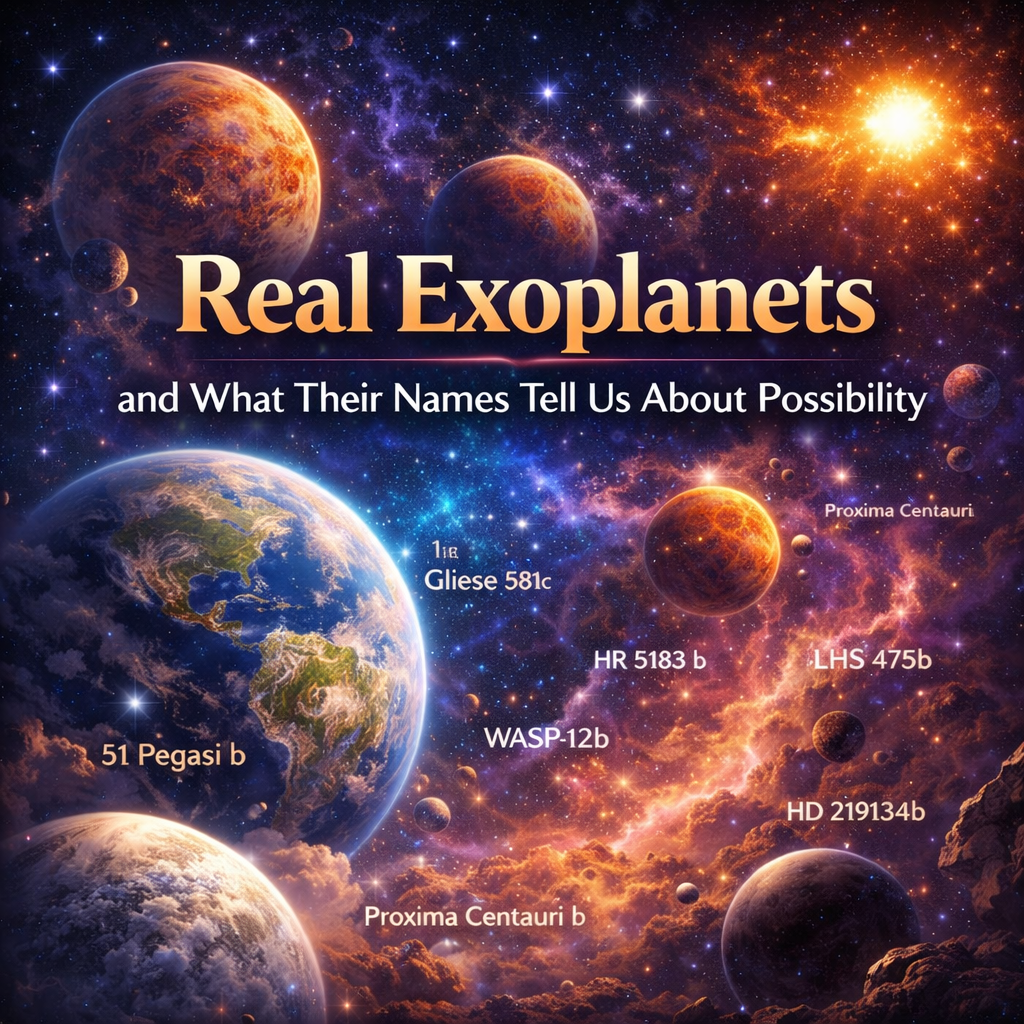
7. Real Exoplanets and What Their Names Tell Us About Possibility
One of the most unexpectedly inspiring sources for fictional planet names is the catalog of real confirmed exoplanets that astronomers have discovered over the past three decades. These are worlds that actually exist orbiting distant stars, some within the circumstellar habitable zone of their suns, some utterly hostile to any life we could recognize and their names span a remarkable range of linguistic and cultural traditions.
The TRAPPIST-1 system, containing seven known exoplanets including several in the habitable zone, takes its name from the Transiting Planets and Planetesimals Small Telescope in Chile. Proxima Centauri b, the nearest known exoplanet to our solar system, orbits within the habitable zone of its red dwarf host a name that sounds both Latin and immediate, as if it is already waiting for us to arrive. Kepler-452b sometimes called ‘Earth’s cousin’ carries the clinical precision of its Kepler designation, while K2-18b, recently identified as a potential Hycean world with possible biosignature gases in its atmosphere, sounds quietly dramatic despite its alphanumeric label.
These real names do something interesting for fiction writers: they establish a range of naming registers that all feel authentic. A world with a proper name from an indigenous tradition, a world with a Latin catalog number, a world named after the telescope that found it all of these conventions are now part of the accepted grammar of how humans talk about other planets. A planet name generator that draws on this range gives creators the freedom to choose their register deliberately: the epic proper name for a planet at the center of the narrative, the cold designation for a frontier world not yet worth naming, the indigenous-tradition name for a world whose inhabitants have been there far longer than the protagonists.
8. Mining Mythology for Planet Names: A Deep Dive into Global Traditions
The most enduringly resonant planet names both real and fictional tend to draw from mythology in some form, and the depth of mythological tradition available to a planet name generator is genuinely staggering. Most creators are familiar with the Greek mythology and Roman mythology that underpins the names of our own solar system’s planets. Zeus, Ares, Aphrodite, Helios, Selene these names carry millennia of narrative and emotional weight. But they represent only a fraction of the mythological palette available.
Norse mythology offers a particularly rich vein for planet names. The Norse cosmological framework with its nine worlds organized around the world tree Yggdrasil already thinks in terms of distinct planetary realms, each with its own character. Names drawn from this tradition tend to have a hard, northern quality: Asgard sounds like a place of power and cold light; Niflheim sounds like darkness and ice; Muspelheim sounds like fire and destruction all of which translate naturally into planetary contexts.
Sumerian cosmology and Babylonian astronomy offer some of the oldest astronomical naming traditions in the world, and words like Tiamat (associated with primordial chaos and the sea or Marduk (the chief Babylonian deity carry a weight of genuine antiquity. Hindu cosmology provides vast cosmological frameworks the concept of multiple cosmic cycles and layered universes that suggest naming conventions of extraordinary scope and spiritual depth. A planet name generator drawing from Sanskrit-inspired roots might produce names like Surya-Veth, Kalindra, or Brahmarion names that feel like they belong to worlds with deep philosophical traditions.
Note: Other Useful pages reference: There are more tools offered from us like Middle Name Generator, Island Name Generator and many other useful tools like Pet Name Generator as well.
9. Using a Planet Name Generator for Sci-Fi Writing, RPGs, and Game Design
The practical applications of a planet name generator extend far beyond novel writing into almost every creative field that involves building fictional worlds. Tabletop RPG designers and game masters running space opera campaigns need dozens of planets each with a distinct enough name that players can remember and distinguish them, but varied enough in character to suggest different environments and cultures. A planet name generator allows a GM to populate an entire stellar system in minutes, generating names that feel consistent within a single universe’s naming tradition while still being individually distinct.
Video game designers face a similar challenge at a much larger scale. Games that feature procedurally generated universes where players can travel between hundreds or thousands of systems need naming algorithms that produce procedural planet names that feel organic and varied without becoming repetitive or meaningless. The principles that guide a good planet name generator phonetic variety, cultural range, length distribution, avoidance of awkward consonant clusters are the same principles that underpin the naming systems in games with procedural generation. Understanding these principles helps designers build better systems and helps players appreciate the worlds those systems create.
For science fiction writing at any level from short stories to epic trilogies the planet name generator serves as a first-draft collaborator. Few writers generate a name and use it unchanged; instead, the generator’s output becomes raw material for refinement. A suggested name might be slightly wrong in one phoneme but exactly right in its overall shape, and adjusting that single sound produces the name the story needed. This iterative process generate, evaluate, refine is how most professional world-builders actually work, and understanding it makes the tool far more effective than treating its output as final answers rather than starting points.
10. Naming Habitable Worlds: The Special Challenge of Earth-Like Planets
Of all the worlds a planet name generator might be asked to name, habitable planets those within the Goldilocks zone of their stars, with liquid water and breathable atmosphere, capable of supporting complex life carry perhaps the heaviest naming burden. These are the worlds where civilizations rise and fall, where histories are written and forgotten, where the full spectrum of sentient experience plays out. Their names need to do more work than the name of a dead rock or a distant gas giant.
The challenge is balance: a habitable planet‘s name should feel welcoming enough to suggest the possibility of life while remaining alien enough to remind the reader that this is not Earth. Too familiar, and the name fails to transport the imagination. Too alien, and it becomes difficult to connect with emotionally. Names that thread this needle tend to share certain characteristics: they are pronounceable and memorable, they have a certain musicality or rhythm, and they often contain echoes of real-world words without being directly derived from them.
The astrobiology context matters here as well. A world that harbors microbial life in a subsurface liquid ocean beneath an icy crust a world like a real Europa but larger might take a name that suggests hidden depth and cold mystery. A world teeming with alien ecosystems and native fauna visible from orbit might deserve a name that sounds verdant and alive. A world that recently hosted sentient life but is now a dead planet after some catastrophe might carry a name that sounds beautiful but carries a note of elegy a name that sounds like it was given by someone who loved the world and lost it.
11. Building a Consistent Naming System Across an Entire Universe
One of the most sophisticated uses of a planet name generator is not generating individual names but establishing a consistent naming convention that applies across an entire fictional universe a system that makes it immediately apparent, from the name alone, which civilization named a world, when it was discovered, and what relationship the namers had with it.
In the real universe, this kind of systemic consistency already exists. Planets in our solar system follow the mythological tradition of Roman mythology. Moons of Uranus are named after characters from Shakespeare and Alexander Pope a tradition that gives them a distinctly literary quality compared to the mythological moons of Jupiter and Saturn. This is not accidental: it reflects the different intellectual traditions that dominated astronomy at different periods of discovery. A fictional universe can use the same principle deliberately, designing naming conventions that reveal as much about the civilizations that did the naming as about the worlds themselves.
A creator might decide, for instance, that planets named by the original colonizing civilization use Sanskrit-inspired polysyllabic names, while worlds discovered later by a second civilization use shorter, Norse-inspired names. Worlds that changed hands after conflict might carry both names the old name still used by the indigenous population, the new name imposed by the conquering power. The planet name generator becomes a tool not just for generating individual names but for maintaining the internal logic of a narrative universe where names carry political and cultural information as well as identification.
12. Common Mistakes When Naming Fictional Planets and How to Avoid Them
Even experienced world-builders fall into certain traps when naming planets, and a planet name generator can actually help identify and avoid these pitfalls by generating a broad range of options that reveal, by contrast, what is not working in a creator’s instinctive choices.
The first and most common mistake is what might be called the descriptive name trap: naming a planet after its most obvious physical characteristic. The Ice Planet, the Fire World, the Desert Star. These descriptions are transparent but they are not names they tell you what the world is rather than giving it an identity of its own. The real desert planet in the Dune universe is not called ‘the desert planet’ it is called Arrakis, which is far more interesting precisely because it does not explain itself. A planet name generator helps break this habit by offering names that have no obvious descriptive meaning, forcing the imagination to project character onto the world rather than reading character off its surface.
The second common mistake is phonetic inconsistency within a single universe: mixing names that sound like they come from completely different linguistic traditions without narrative justification. A universe where one planet is called Xhar’eth, another is called Greenfield, and a third is called Tau Ceti IV is not necessarily incoherent, but it requires explanation each naming convention implies a different origin, a different era of discovery, a different cultural background. Using a planet name generator to establish a consistent phonetic palette for a universe, and then sticking to it, produces a much more believable planet name landscape across an entire fictional setting.
13. Planet Names for Specific Environments: A Practical Reference
Different planetary environments lend themselves to different naming approaches, and a good planet name generator should ideally allow creators to filter or orient their results toward the kind of world they are trying to name. Here is a practical guide to the phonetic and structural approaches that tend to work best for specific planetary types:
Frozen planets and ice worlds: Names with long, cold vowel sounds and fricative consonants tend to work well Krelvath, Syrenne, Vhorath. The Nordic and Old English phonetic palette is particularly suited to worlds of permafrost and polar ice, as these languages evolved in cold northern environments and carry that quality in their sound.
Volcanic and lava worlds: Hard plosives, short vowels, and an overall sense of abrupt percussion Kaldrath, Gruvek, Sorroc. These names feel hot and violent in the mouth, which suits a world where volcanic activity shapes every landscape feature and tectonic activity never truly stills.
Oceanic and water worlds: Flowing consonants, open vowels, and rhythmic multi-syllable structures Miralos, Velanthu, Surethaan. These names have a wave-like quality when spoken aloud, matching the global ocean and ocean basin landscapes of worlds where water is the dominant force.
Ancient and mysterious planets: Long names with archaic phoneme clusters and ambiguous cultural origins Valdehren, Thureth-Kai, Ossivari. These feel like names that carry centuries of history and perhaps a note of warning the kind of name that experienced spacers say quietly and with respect.
14. Drawing Inspiration from Real Space Science for More Authentic Planet Names
One of the most effective ways to make fictional planet names feel genuinely authentic is to draw inspiration from the actual scientific vocabulary of planetary science the terms that astronomers, astrobiologists, and space scientists use when describing the properties of real worlds. This approach, used thoughtfully, creates names that carry an implicit scientific credibility even when they are entirely invented.
Consider how many beautiful and evocative scientific terms are already available: magnetosphere, albedo, perihelion, aphelion, axial tilt, cryovolcanism, biosignature. None of these are planet names, but fragments of them could easily become planet names or at least the raw material from which names could be constructed. ‘Alberon’ echoes albedo. ‘Perithon’ carries the rhythm of perihelion. ‘Cryovath’ combines cryovolcanism with a satisfying hard ending. The exoplanet catalog itself is full of words TRAPPIST, Kepler, Hycean, Proxima that have become part of the shared vocabulary of planetary imagination and that a skilled planet name generator can use as phonetic raw material.
The James Webb Space Telescope has recently expanded this vocabulary dramatically, identifying new categories of worlds the Hycean world, the temperate sub-Neptune that did not even have names a decade ago. Each new discovery creates new naming possibilities, new phonetic material, and new scientific concepts that creative writers can draw on to make their fictional planetary science feel current and grounded in real discovery.
15. Getting the Most from a Planet Name Generator: A Creator’s Workflow
Using a planet name generator effectively is as much a matter of creative process as it is of the tool’s capabilities. The creators who get the most out of these tools tend to follow a workflow that treats generated names as raw material rather than finished products a starting point for a process of refinement, association, and discovery rather than a final answer to be accepted or rejected.
The first step in this workflow is to generate broadly asking for a large number of names across multiple styles and filtering settings before making any judgments. A batch of twenty or thirty names will always contain more useful material than a batch of five, because the sheer variety reveals what your creative instincts are drawn to. Pay attention not just to the names that immediately appeal but to the ones that prompt a specific visual or emotional reaction even if that reaction is uncertainty. A name that makes you feel slightly off-balance might be exactly right for a rogue planet or an uninhabitable planet with an unsettling history.
The second step is what might be called phonetic editing taking the names that feel almost right and adjusting individual sounds until they feel exactly right. Change a single vowel. Move a consonant cluster. Shorten a syllable or add one. This is micro-level work, but it is often where the real creative value is generated. The third step is etymology building asking what the name might mean in the language of the people who gave it, and using that invented meaning to deepen the lore creation process. A planet name generator opens a door. Walking through it that is the creative work that turns a tool’s output into a world.
Frequently Asked Questions
Q1: How does a planet name generator actually create names?
A planet name generator typically works through one of several underlying mechanisms, depending on how sophisticated it is. The simplest tools use procedural name generation randomly combining syllable units drawn from a predefined library organized by phonetic style (harsh, soft, classical, alien. More advanced generators use Markov chains or neural models trained on existing planetary names real names from the NASA exoplanet archive, mythological traditions, and constructed language databases to produce outputs that statistically resemble their training material while still generating novel combinations. The best generators combine both approaches with style filters that let users specify parameters like ‘consonant-heavy,’ ‘Latin-derived,’ or ‘multi-syllable,’ producing outputs that feel both random and intentionally shaped.
Q2: What makes a fictional planet name sound believable?
Believability in a fictional planet name comes from several converging factors. First, pronounceability a name that a reader can sound out instinctively, without stumbling over impossible consonant clusters, will feel more real than one that exists only on the page.
Second, phonetic consistency a name that follows recognizable patterns from a real language family (even if the connection is not explicit carries the weight of that tradition. Third, appropriate length most memorable planet names are between two and four syllables; shorter can work for dramatic effect, longer risks becoming unwieldy. Finally, naming convention consistency within the universe it belongs to is perhaps the most powerful credibility factor of all.
Q3: Can I use a planet name generator for professional projects?
Yes and many professional writers, game designers, and creative teams do exactly that, typically using generator output as a starting point for refinement rather than a finished product. The planet name generator is a creative accelerator, not a replacement for creative judgment. For a published novel or major game release, the names generated by any tool would typically be subjected to several rounds of review: checking for unintended meanings in multiple real-world languages, evaluating phonetic consistency with the universe’s established naming conventions, and testing memorability and distinctiveness across the full cast of planetary names in the setting. The generator’s contribution is eliminating the blank page problem giving the creative process something concrete to react to.
Q4: What is the difference between planet names in hard sci-fi versus space opera?
This is one of the most practically useful distinctions for anyone using a planet name generator for creative work. Hard science fiction the genre committed to scientific plausibility tends to favor naming conventions that feel continuous with real astronomical nomenclature. Planets might carry designations that reflect their stellar system and orbital radius, or proper names drawn from the cultural traditions of the colonizing civilization in a way that could plausibly have happened. Space opera, by contrast, prioritizes emotional and narrative impact over scientific plausibility. Names like Coruscant, Tatooine, and Arrakis are immediately evocative and memorable they work as story elements first and astronomical designations a distant second. Both approaches are valid; the important thing is knowing which mode your project is operating in before you start generating names.
Q5: How many planet names should a fictional universe have?
There is no universal answer, but a useful principle is that every planet that appears significantly in the narrative where scenes are set, where characters live, where major events unfold deserves a fully developed, carefully considered name. Background planets worlds mentioned in passing as part of a stellar system or a trade route can carry names generated more quickly, as long as they feel tonally consistent with the universe’s naming tradition. The risk of over-naming is that readers lose track of which world is which; the risk of under-naming is that the universe feels thin and unconstructed. As a general guideline, give your three or four key planets names that you can explain and defend phonetically, and let your planet name generator handle the background catalog with stylistically consistent bulk generation.
Q6: Should every planet in a story have a unique naming origin?
Not necessarily and in fact, naming convention consistency within a civilization’s sphere of influence can be a powerful world-building tool. If all the planets colonized by a particular empire use a Latin-derived naming structure, that tells the reader something about the empire’s cultural heritage and its relationship to classical knowledge. If a conquered people’s homeworld has a name that clearly comes from a completely different phonetic pattern and naming tradition, that linguistic difference becomes a visible marker of cultural identity and historical conflict. A planet name generator that allows you to generate names in different stylistic modes makes this kind of layered naming architecture genuinely practical.
Q7: How do real astronomers choose names for newly discovered exoplanets?
The naming of newly discovered exoplanets is governed by the International Astronomical Union, which maintains strict guidelines about astronomical naming conventions. Initially, all newly confirmed exoplanets receive a catalog designation based on their host star’s name or catalog number, followed by a lowercase letter indicating the order of discovery within that system (b for the first, c for the second, and so on. The first confirmed exoplanet around a sun-like star 51 Pegasi b exemplifies this system. The IAU then periodically runs public naming campaigns called NameExoWorlds that invite proposals from the global public. Names must be drawn from cultural heritage, mythology, or literature; they must not be commercially related; and they must be approved by the IAU’s working group on star names before becoming official. The result is a growing catalog of exoplanet proper names that reflects the genuine cultural diversity of humanity’s relationship with the sky.
Conclusion: The Name Is Where the World Begins
We have traveled a long way in this guide from the Babylonian astronomy that gave the classical planets their first divine names, to the IAU naming rules that govern the naming of worlds like Proxima Centauri b and Kepler-452b, to the creative principles that allow a planet name generator to become a genuine partner in the worldbuilding process. Along the way, we have explored the phonetics and phonology of world-naming, the depth of mythological tradition available to any creator willing to look beyond Greek mythology and Roman mythology, the lessons embedded in fictional masterworks like Arrakis and Tatooine, and the practical workflows that help transform a tool’s generated suggestions into names that are truly, irreversibly owned.
What emerges from all of this is a simple but profound truth: naming a planet is never just a naming exercise. It is the first act of creation in a long chain of creative decisions. The sounds you choose, the cultural traditions you draw from, the length and rhythm and phonetic character of the name you settle on all of these choices send ripples forward into every other element of the world you are building. The lore creation begins with the name. The alien civilization takes shape around it. The creation myth that a culture tells about its homeworld grows from the meaning embedded in those first syllables.
A planet name generator is, at its best, a tool that respects this chain of creative causality. It does not make the choices for you it opens a space of possibility and gives you something concrete to react to. The generated name that sparks a reaction, that makes you ask ‘what kind of world would have a name like that?’ that is the tool doing its job. And the creative work that follows that question the worldbuilding, the history-building, the culture-building that is the irreplaceable human work that no algorithm can perform.
Whether you are a novelist three hundred pages into a science fiction trilogy that needs a dozen more systems named before the final act, a game master building a campaign setting that will carry your players through a year of sessions, a game designer seeding a procedurally generated universe with worlds that feel real despite being algorithmically created, or simply a curious mind who has always wanted to know what it would feel like to name a world a planet name generator is ready to help you find what you are looking for. The universe is vast, the stars are uncountable, and every one of them that hosts a world deserves a name worth saying aloud.
So go ahead. Generate something. See what sparks. A habitable zone world waiting for its first civilization. A rogue planet drifting cold and alone between the stars. A gas giant with seven natural satellites, one of which harbors a subsurface ocean beneath two kilometers of ice. Each of them is waiting for the name that will make them real and a planet name generator is the fastest, most productive way to start that search. The name is where the world begins. Begin.
Published for beastskins.com Fueling creativity across every universe you build.